Approved Document M
New Part M research has been undertaken by ARUP Consultants to understand the requirements of the population in England in relation to the built environment, in particular disabled people and people with long-term health conditions, to inform a possible update to Approved Document M (ADM) Volumes 1 and 2.

Part M
The Key aims of the research were to:
- Understand what current evidence, data and research exists about the population in England, in particular disabled people and people with long-term health conditions.
- Produce new, up-to-date experimental and qualitative data, about the requirements of disabled people and people with long-term health conditions.
- Provide findings and identify recommendations or areas for future research for the Department of Levelling Up, Housing and Communities (now Ministry of Housing, Communities and Local Government) to consider as part of any updates to ADM Volumes 1 and 2.
- Understand what current evidence, data and research exists about the population in England, in particular disabled people and people with long-term health conditions.
- Produce new, up-to-date experimental and qualitative data, about the requirements of disabled people and people with long-term health conditions.
- Provide findings and identify recommendations or areas for future research for the Department of Levelling Up, Housing and Communities (now Ministry of Housing, Communities and Local Government) to consider as part of any updates to ADM Volumes 1 and 2.
The Conclusion of the report states:
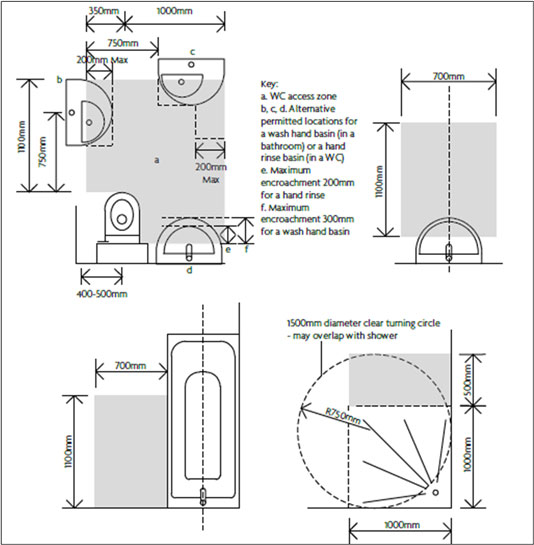
‘The findings from the research indicate that the spatial dimensions for access provided in current guidance, including ADM (Volumes 1 and 2), are generally too small for a wide range of disabled people and people with long-term health conditions.
Disabilities are often treated separately in design guidance, but co-occurrence of disability is high. Disabled people often also use more than one type of mobility aid. This means disabled people’s spatial needs are complex. Despite this, designing for access tends to focus primarily on independent wheeled mobility aid users.
This research indicates that people’s spatial needs are also significantly influenced by other factors, including being accompanied by companions (e.g. assistants; family; children etc.); personal adaptation / additions to wheeled mobility aids; using additional mobility aids simultaneously; individual manoeuvring and transfer style etc.
Consequently, significant numbers of disabled people appear to ‘put up’ with non-accessible spaces, or completely avoid them – people tend to have a good idea of where they can and cannot go. This means access issues with design are likely to go unaddressed.
While a significant number of the key items generally limiting access to the built environment are currently not included within the guidance in ADM (Volumes 1 and 2), they are included in BS 8300 Parts 1 and 2 (but BS 8300 is not currently a statutory building standard).’
Further research is suggested.
The findings and recommendations form part of the technical review of the statutory guidance for accessibility in buildings in England. They do not represent Government policy or guidance.
Download:
Access to and use of buildings research on demographic and ergonomic requirements
Access to and use of buildings research on demographic and ergonomic requirements - appendices
For more information visit: https://www.gov.uk/government/publications/access-to-and-use-of-buildings-research-on-demographic-and-ergonomic-requirements
Want to find out more?
Discover our latest News & Media

Visit: Shelters for the Senses

Industry Briefing - updates and reminders

Competition to build National Muslim War Memorial - lasting tribute to bravery and sacrifice
Building Control Independent Panel: Government response to report

AI tools will “Slash planning decision times”- Government unveils plans to halve planning delays…

Have your say: A new strategy for the built environment professions, trades and occupations…

Building Safety in Wales – Developers take note: a different system for higher-risk buildings…

The Past, Present and Future of Building Control – “…There will inevitably be more changes to Regulations, processes and procedures…”